What to Plant With Daylilies: Companion Perennials That Actually Work Together

12 min read
Contents
- Match Growing Conditions Before Matching Colours
- Light requirements come first
- Water and soil preferences matter just as much
- Companion plants at a glance
- The Best Companions for a Sunny Daylily Border
- Catmint, salvia and hardy geraniums for the front
- Coneflowers, black-eyed Susans and bee balm for summer colour
- Phlox, asters and ornamental grasses for height and late-season interest
- Can You Grow Daylilies and Hostas Together?
- Where the sun-to-shade transition makes sense
- When the pairing is likely to disappoint
- Choose Companions That Fill the Gaps in Bloom Time
- Three Planting Combinations for Different Gardens
- A sunny, low-maintenance front-yard border
- A mixed border with morning sun and afternoon shade
- A border designed for late-summer interest
- Pairings to Avoid or Reconsider
A border filled with daylilies can be spectacular in July and surprisingly quiet a few weeks later. Their arching leaves remain, but the flowers disappear as each variety finishes its display. The right companion perennials solve that problem while adding different shapes, textures and colours throughout the growing season.
Some of the most useful partners are catmint, salvia, coneflowers, black-eyed Susans, hardy geraniums and fall-blooming asters. Hostas can work beautifully, too, provided the planting moves from sun into shade.
The best combinations are not necessarily the ones with the most flowers. They are the ones where every plant has the light, moisture and space it needs to thrive.
Match Growing Conditions Before Matching Colours
Daylilies (Hemerocallis) generally perform best in well-drained soil with at least six hours of direct sunlight. They tolerate a range of soil conditions and become reasonably drought-tolerant once established, although consistent moisture supports better flowering.
Their companions should be comfortable under similar conditions, or occupy a distinct part of the bed where their requirements can be met.
Light requirements come first
A sunny border offers the widest choice. Catmint, salvia, coneflowers and many ornamental grasses all grow well alongside daylilies where direct sunlight is plentiful.
Part shade requires more planning. Daylilies can tolerate some shade, but their flower production often declines as light decreases. Hostas and heucheras, meanwhile, can appreciate protection from intense afternoon sun.
Where sunlight changes across a bed, arrange the plants according to that gradient rather than treating the entire space as one growing environment.
Water and soil preferences matter just as much
A plant that tolerates dry soil is not automatically compatible with one that prefers consistent moisture.
Catmint and upright stonecrop are good choices for relatively dry, well-drained borders. Bee balm and garden phlox generally appreciate more reliable moisture, particularly during active growth.
These plants can share a larger garden, but their placement and watering may need to differ.
Before buying, check the mature spread and hardiness of each cultivar. Natural Resources Canada’s updated plant hardiness mapping reflects climate conditions from 1991 to 2020, but a zone rating alone cannot tell you whether a plant will tolerate waterlogged winter soil or a particularly exposed location.
Companion plants at a glance
| Companion | Light | Moisture | Typical height | Main interest | Cold-climate consideration |
|---|---|---|---|---|---|
| Catmint (Nepeta) | Full sun | Dry to average | 30–60 cm | Late spring–summer | Many cold-hardy selections |
| Woodland sage (Salvia nemorosa) | Full sun | Average, well-drained | 30–60 cm | Early–midsummer | Check cultivar hardiness |
| Hardy geranium (Geranium) | Sun–part shade | Average | 25–50 cm | Late spring–summer | Hardiness varies by species |
| Coneflower (Echinacea) | Full sun | Dry to average | 60–100 cm | Midsummer–early fall | Hardy selections available for cold regions |
| Black-eyed Susan (Rudbeckia) | Full sun | Average | 45–90 cm | Midsummer–fall | Many reliably hardy perennial forms |
| Bee balm (Monarda) | Sun–part shade | Average to moist | 60–120 cm | Midsummer | Choose hardy, mildew-resistant cultivars |
| Garden phlox (Phlox paniculata) | Full sun | Average to moist | 60–120 cm | Midsummer–late summer | Hardy cultivars available; airflow matters |
| Asters (Symphyotrichum) | Sun–part shade | Varies by species | 40–150 cm | Late summer–fall | Many cold-hardy native choices |
| Upright stonecrop (Hylotelephium) | Full sun | Dry to average | 30–60 cm | Late summer–fall | Many hardy selections; drainage is essential |
| Hostas (Hosta) | Part–full shade | Average to moist | 20–90 cm | Spring–fall foliage | Many hardy selections; size varies widely |
Heights and bloom periods are approximate. Cultivar selection, local climate and growing conditions can change them substantially. Check whether the hardiness rating on a plant label uses the Canadian or USDA system, since the two are calculated differently.
The Best Companions for a Sunny Daylily Border
Daylilies have substantial, strap-like leaves and relatively large flowers. They look especially effective beside plants with finer foliage, upright flower spikes or smaller, more numerous blooms.
Think about the border in three layers: low plants at the front, daylilies and medium-height companions in the middle, and taller perennials behind them.
Catmint, salvia and hardy geraniums for the front
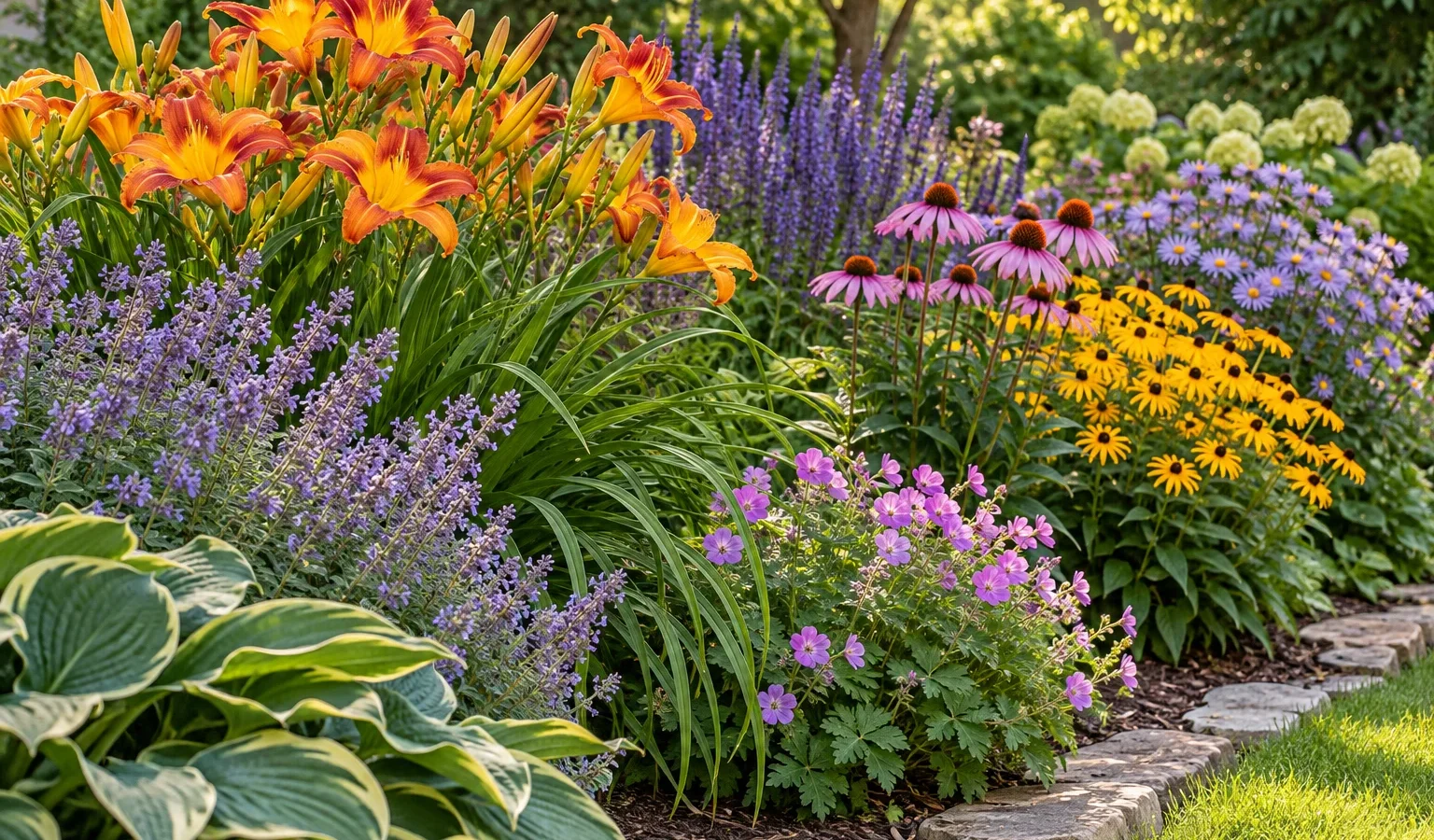
Catmint (Nepeta) is particularly useful beside yellow, orange or peach daylilies. Its blue-violet flowers create a cool contrast, while its soft, mounding foliage helps conceal bare soil.
Compact forms such as ‘Cat’s Pajamas’ suit smaller borders. Larger varieties need more space and can spread across paths if placed too close to an edge.
Catmint flowers often begin before the main daylily season. Trimming spent growth may encourage fresh foliage and additional flowers, depending on the cultivar and climate.
Woodland sage (Salvia nemorosa) creates a different effect. Its vertical purple or violet flower spikes contrast with the broader shape of daylily blooms. Some cultivars produce another flowering flush after their first spikes are removed.
Hardy geraniums, particularly spreading cranesbills, provide a softer foreground. Their foliage fills gaps between larger plants and remains useful after the first flowers fade. ‘Rozanne’ is valued for its long flowering period, although gardeners in colder locations should verify its suitability before planting.
These three choices work best when they soften the front of the clump without covering the daylily’s crown.
Coneflowers, black-eyed Susans and bee balm for summer colour
Purple coneflower (Echinacea purpurea) is a natural partner for daylilies. Its upright stems and daisy-like flowers contrast with the daylily’s arching foliage, while the seed heads remain attractive after flowering.
Pink coneflowers beside golden-yellow daylilies create a warm, relaxed combination. White-flowered coneflowers offer a quieter alternative.
Black-eyed Susans (Rudbeckia) carry yellow and gold tones into late summer. Perennial selections such as Rudbeckia fulgida ‘Goldsturm’ are useful where dependable flowering and manageable growth are priorities.
Bee balm (Monarda) introduces a looser, more naturalistic look. Its unusual flower heads attract pollinators and contrast strongly with daylily flowers.
Bee balm needs a little more consideration, though. Many cultivars spread through underground stems and can develop powdery mildew when crowded. Choose a mildew-resistant variety and provide enough space for airflow.
Phlox, asters and ornamental grasses for height and late-season interest
Garden phlox (Phlox paniculata) produces dense clusters of flowers above the main daylily foliage. It works well behind medium-height cultivars, especially in borders with reasonably fertile soil and dependable moisture.
Avoid packing phlox tightly against other tall plants. Good airflow and resistant cultivars help reduce powdery mildew problems.
Fall-blooming asters, particularly appropriate Symphyotrichum species, become valuable as summer flowers fade. Purple, blue or pink daisy-like blooms can extend the display into early autumn. Some species spread readily, so match the selection to the available space.
Ornamental grasses contribute a different kind of interest. Feather reed grass provides upright structure, while suitable switchgrass (Panicum virgatum) cultivars add movement and autumn colour.
Grasses also give the border something attractive to look at after the last flowers have finished.
Can You Grow Daylilies and Hostas Together?
Yes. Daylilies and hostas can make an excellent combination, but the best location is usually a transition between sun and shade rather than a uniformly exposed bed.
Where the sun-to-shade transition makes sense
Imagine a border that receives direct morning sunlight before a nearby tree casts afternoon shade.
Daylilies can occupy the brighter section, while hostas grow farther into the shaded area. The daylily flowers provide summer colour; the hosta leaves supply broad, sculptural shapes from spring until frost.
Blue-leaved hostas generally need more shade to preserve their characteristic appearance. Gold and some variegated cultivars can tolerate a little morning sun, although their preferences differ.
Heucheras work well in the transition zone, adding burgundy, lime or amber foliage between the two larger plants.
When the pairing is likely to disappoint
A fully exposed, dry south-facing bed is rarely ideal for ordinary hostas. Their leaves may scorch, particularly when afternoon heat combines with insufficient moisture.
Deep shade creates the opposite problem. Hostas may remain attractive while daylilies produce few flowers.
Root competition also matters. Planting both directly beneath a mature maple or spruce can leave them competing for water even when the light seems suitable.
If the location is genuinely shady, a hosta-and-fern planting may perform better than trying to force daylilies into unsuitable conditions.
Choose Companions That Fill the Gaps in Bloom Time
Most individual daylily cultivars flower for several weeks rather than throughout the entire summer. Early, midseason and late varieties can extend the display, but companion plants provide a more dependable way to maintain interest.
In a typical southern Canadian perennial border, the progression might look like this:
- Late spring to early summer: Catmint, salvia and some hardy geraniums begin flowering while daylily foliage develops.
- Midsummer: Daylilies take centre stage, accompanied by coneflowers, bee balm and black-eyed Susans.
- Late summer: Garden phlox, Rudbeckia and later daylily varieties maintain colour.
- Early fall: Asters and upright stonecrop become more prominent, alongside the seed heads and foliage of ornamental grasses.
These are seasonal relationships, not fixed flowering dates. Bloom may begin considerably later in a short-season Prairie garden than in a mild coastal location.
Foliage should be part of the plan as well. Hosta leaves, ornamental grasses and the rounded forms of stonecrop provide visual structure even when few plants are flowering.
For pollinator interest, combine different flower shapes and successive bloom periods. The University of Saskatchewan’s gardening resources recommend offering a diversity of flowers throughout the season, including coneflowers, bee balm, asters and salvias.
Three Planting Combinations for Different Gardens
The following layouts are practical starting points rather than fixed planting prescriptions. Their suggested spacing refers to approximate distances between plant centres; adjust it according to the mature dimensions on each cultivar’s label.
A sunny, low-maintenance front-yard border
Suggested area: 1.5 m × 4 m, with at least six hours of direct sunlight.
Planting combination:
- 4 compact or medium-height daylilies
- 3 coneflowers
- 5 compact catmints
Place the coneflowers towards the rear, in a loose group. Arrange the daylilies across the middle and repeat catmint along the front, leaving openings where it can spread naturally.
Allow approximately 60–75 cm between daylily centres, 45–60 cm for coneflowers and the mature spread recommended for the catmint cultivar, often around 40–60 cm.
Choose one main daylily colour, such as gold or soft peach, rather than several unrelated colours. Purple catmint and pink coneflowers provide contrast without making the composition feel crowded.
This arrangement suits a relatively sunny bed with average, well-drained soil. Once established, the plants generally tolerate occasional dry periods, though prolonged drought can reduce flowering.
A mixed border with morning sun and afternoon shade
Suggested area: 2 m × 4 m, with a genuine gradient from brighter to shadier conditions.
Planting combination:
- 3 daylilies
- 3 medium-sized hostas
- 3 heucheras
- 2 hardy geraniums
Position the daylilies at the sunny edge, preferably where they receive close to six hours of direct light. Place hostas in the shadier section, keeping enough room for their mature leaf spread.
Use heucheras and hardy geraniums as transitions between the larger plants.
Daylilies may need roughly 60–75 cm between centres, while medium hostas commonly need 60–90 cm or more. Smaller heucheras can often be spaced around 35–45 cm apart.
This combination works best where soil retains moderate moisture without becoming waterlogged.
Avoid treating it as a solution for deep shade. If the entire area receives very little direct sunlight, replace the daylilies with shade-tolerant perennials.
A border designed for late-summer interest
Suggested area: 2 m × 5 m, in full sun.
Planting combination:
- 4 daylilies, preferably with different bloom periods
- 3 compact fall-blooming asters
- 4 upright stonecrops
- 2 clump-forming ornamental grasses
Place the grasses towards the rear as structural accents. Use daylilies through the central area, with asters in smaller repeated groups and stonecrop towards the front.
Allow roughly 60–75 cm for daylilies, 45–60 cm for compact asters and stonecrop, and sufficient space for the mature width of the selected grasses. The overall layout should remain open enough for airflow and future growth.
Stonecrop works particularly well here because it provides neat, fleshy foliage before its late-season flowers appear. Asters then supply additional colour when most daylilies have finished.
Choose grasses and asters that suit your hardiness zone, and avoid varieties that grow too tall or spread too aggressively for the available space.
These combinations are a starting point; a complete daylily border layout also needs enough room for mature clumps, clear sightlines and a sequence of flowers across the summer.
Pairings to Avoid or Reconsider
Some combinations look convincing in photographs but require more maintenance than expected.
Hostas in hot, exposed daylily beds: The daylilies may thrive while hosta leaves suffer sunscald. Use hostas where afternoon shade and adequate moisture are available.
Moisture-loving plants beside drought-adapted companions: Bee balm and phlox may need more regular watering than catmint or stonecrop. Group plants according to moisture requirements rather than assuming one watering schedule suits everything.
Tall, dense plants directly in front of daylilies: Vigorous phlox, large grasses or tall asters can obscure flowers and reduce airflow. Keep the taller plants towards the back or between substantial groups.
Aggressive spreaders near smaller cultivars: Some asters, bee balms and older orange daylilies can expand beyond their allotted space. The common orange daylily (Hemerocallis fulva) has also been identified as an invasive concern in parts of southern Ontario, so it should not be treated as interchangeable with every ornamental daylily cultivar. Check local guidance when selecting vigorous species.
Too many individual varieties: A border containing one plant of every colour may look fragmented. Repeating two or three dependable companions usually creates a stronger composition than collecting a dozen unrelated specimens.
Ignoring the mature size: A young perennial border often appears sparse, tempting gardeners to add more plants. Within a few seasons, those same plants may compete for space, water and light. Allow the garden to develop before filling every gap.
There is no single perfect companion for every daylily. A sunny, relatively dry bed calls for a different combination from a moist, partly shaded garden, and a short-season location may benefit more from reliable foliage and hardy late bloomers than from varieties promising repeated flowers.
Start with the conditions already present, choose companions that perform different jobs across the season, and give each plant enough room to mature. The result should be a border that remains interesting well beyond the daylilies’ main flowering weeks.